
SriSemantanGold.com
"Gold Works, You Relax"

Kedai Emas Sri Semantan
Profit Sharing
KESS business operates on the Islamic financing concept of Mudharabah, a profit-sharing partnership built on fairness and transparency.
By Adopting Profit Sharing/Mudharabah, KESS Offers An Openness Approach That Promotes Ethical Business, Shared Responsibility, And Mutual Benefit


How KESS Executes Its Business & Offers Profit Sharing To Members?

EFFECTIVE STRATEGIES FOR MANAGING CAPITAL FOR KEDAI EMAS SRI SEMANTAN (KESS)
PROFIT ILLUSTRATION FOR GOLD SPOT PRICE


PROFIT ILLUSTRATION FOR SPECIAL TRADE IN
How Does KESS Generate Profit Through Special Trade In (STI)?
1. Assume the Customer Delivers Gold to KESS via STI:
-
1,000 grams of 916 gold
KESS Does Not Need to Invest Capital to Purchase This Gold Because the Gold Stock Has Been Provided by the Customer.
2. KESS Converts Old Gold into New Jewelry
-
By Processing the Gold in Its Own Factory
3. KESS Sells New Gold at a Price:
-
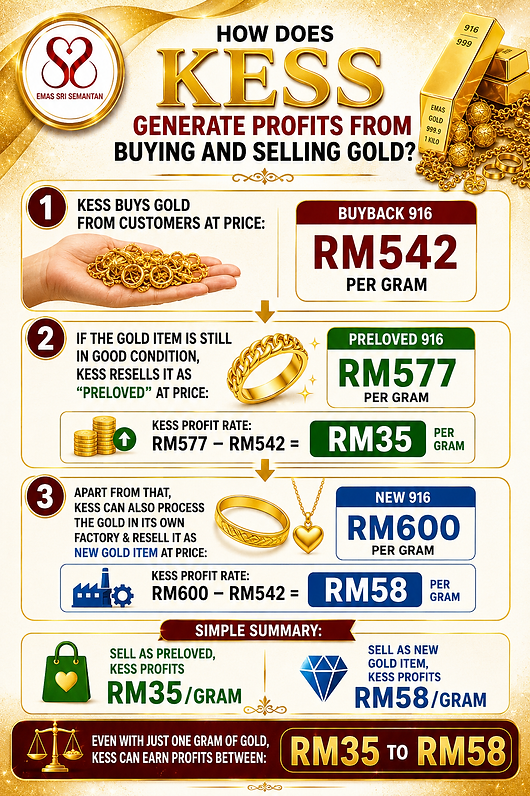
RM600/gram (New 916)
Total Sales Amount:
-
1,000 grams × RM600 = RM600,000
4. With a Sales Revenue of RM600,000, KESS Can Buy Back Used Gold at a Price:
-
RM542 per gram (Buyback 916)
Therefore, the Amount of Gold That Can Be Purchased:
-
RM600,000 ÷ RM542 = 1,107 grams
Excess Gold From the Original Amount:
-
1,107 grams – 1,000 grams = 107 grams
This means that after one round, KESS earns additional:
-
107 grams of gold
5. Assuming this process is repeated 10 times a month, the additional gold obtained by KESS:
-
107 grams × 10 = 1,070 grams
6. If these 1,070 grams are valued at the buyback price of RM545 per gram, the additional value of the gold:
-
1,070 grams × RM545 = RM583,150
This is the estimated monthly gross profit.
KESS Operating Costs (Factory Wages)
A. Estimated Gold Processing Cost:
-
RM10 per gram
For 1,000 grams:
-
RM10,000 Per Round
For 10 Rounds:
-
RM100,000 per month
B. Profit Sharing Payment to SSPC Members:
-
RM25 × 1,000 grams = RM25,000
Matching Bonus:
-
RM7 × 1,000 grams = RM7,000
C. Total Payment to Members:
-
RM32,000 per month
Financial Summary:
-
Monthly Gross Profit = RM583,150
-
Factory Cost = RM100,000
-
Payment to SSPC Members = RM32,000
-
Total Cost = RM132,000
Estimated Net Profit
-
RM583,150 – RM127,000 = RM451,150 per month
Therefore:
From 1,000 grams of gold handed over by customers, KESS can:
-
Sell New Gold.
-
Use the Sales Proceeds to Buy More Gold Stock.
-
Repeat the Process Many Rounds.
-
Generate Much Larger Profits.
-
Pay Profit Sharing to SSPC Members.
In Conclusion:
The Special Trade In (STI) Model Allows KESS to Generate Profits Without Having to Spend Capital to Buy Gold Stock.
As Long as Gold Can Be Processed & Resold Continuously, KESS Has the Potential to Earn Large Retail Profits and Then Share Profits with SSPC Members.
CAPITAL BREAK DOWN FOR KESS

Why Doesn't KESS Make a Loss Even When Gold Prices Fall?
If The Gold Prices Falls, KESS Does Not Necessarily Suffers a Loss.
This Is Because KESS Can Use Its Cash To Buy More Gold At A Cheaper Price.
When Gold Prices Are Lower:
-
KESS Can Get More Grams Of Gold With The Same Amount Of Cash.
-
The Company's Gold Holding Reserve Will Increase.
-
The Company Is In A Stronger Position.
When Gold Prices Rise Again:
-
The Value Of Gold Purchased At A Cheap Price Will Increase.
-
KESS Has The Potential To Make Bigger Profits.
What Is A Gold Spread?
-
A Spread Is The Difference Between The Selling Price Of Gold And The Repurchase Price Of Gold Based On The Spot Price Of Gold At A Time.
For example:
-
Gold Selling Price: RM600/gram (New 916)
-
Gold Buyback Price: RM542/gram (Buyback 916)
-
Spread = RM58/gram
Spread is a trading margin commonly practiced in the physical gold industry worldwide.
What about STI and Gold Saving Customers?
-
Gold only needs to be returned/handed over to SSPC members after the 6-month contract period ends.
-
This gives KESS time to manage the purchase and stock of gold holdings.
-
In most cases, KESS will have sufficient gold stock when the contract matures.
Why are SSPC members not affected by fluctuations in the price of gold?
Gold Saving (GS), Special Trade In (STI) & STI Premium contracts are based on the gram of gold held, not the ringgit value.
For example:
-
A member holds 100 grams of gold.
-
If the price of gold rises, the member still owns 100 grams of gold.
-
If the price of gold falls, the member also still owns 100 grams of gold.
This means that fluctuations in the market price do not change the amount of grams of gold that the member is entitled to. Only the current market value of the gold are affected.
KESS carries out continuous gold trading activities.
Therefore:
-
When the price of gold rises, KESS earns income through the buy-sell spread.
-
When the price of gold falls, KESS still earns income through the buy-sell spread.
In other words, KESS's business profits do not depend solely on the price of gold which is constantly increasing.
On the contrary, KESS Gain Its profits From:
-
Daily gold trading activities.
-
Gold buy-sell spread margin.
-
Efficient Gold Stock Management.
-
Purchase Gold at Competitive Prices.
Summary
✅ Member Contracts Through GS/STI/STI Premium Are Based on Gram Gold Holdings and Not Ringgit Value.
✅ Fluctuations in Spot Gold Prices Do Not Change the Amount of Gram Gold a Member Owns.
✅ KESS Continues to Earn Income Through the Gold Buy-Sell Spread Regardless of Whether the Gold Price Goes Up or Down.
✅ Falling Gold Prices Give KESS the Opportunity to Buy More Gold at a Lower Cost.
✅ The 6-Month Contract Period Gives KESS Time to Manage Gold Stocks and Gold Trading Activities Continuously.
Gold Price Falls = Opportunity to Buy Gold at a Lower Cost.
Gold Price Rises = Potentially Increasing Value of Gold Holdings.
Gold Buy-Sell Spread = Source of Income That Exists in Up and Down Markets.
Therefore, SSPC members' holdings remain based on the grams of gold owned and not based on the fluctuation of the gold price in Malaysian Ringgit.
